⚔
A character worth following
The hero makes decisions, faces setbacks and grows. Their motivations matter as much as their weapons or abilities.
LitRPG AI is a specialized fiction-writing studio designed to help turn a story premise into a structured LitRPG novel—with chapter plans, character progression, continuity checks, and publishing files in one workflow.
Curious whether it lives up to its promise? Explore what the studio offers, what the plans actually include, and what to check before buying.
The fantasy fiction publishing studio
A writing tool built around the rules that make progression fantasy so engaging.
Writing a fantasy adventure is challenging enough. In LitRPG, the author also has to remember skills, inventory, experience points, levels, world rules, and the consequences of every battle. A small contradiction can pull a careful reader out of the story.
LitRPG AI brings planning, drafting and continuity management into a guided studio. According to the product information, writers can choose a tone and protagonist, shape a series concept, review chapter outlines, generate scenes, and check key progression details as the manuscript develops.
Its publishing tools also aim to simplify the work that follows the final chapter: cover preparation, book descriptions, and file exports for Amazon KDP.
Explore the core tools →Imagine an adventure where victories leave a visible record. A character learns a spell, earns experience, unlocks an ability or discovers that a new area has a minimum level. That feedback is part of the story, not a separate game.
There is the emotional journey—what the hero wants, what they fear and who they choose to trust. Then there is the measurable journey, with new skills, stronger abilities and consequences that follow them into the next chapter.
For a novelist, that second journey creates a challenge: skills, inventory, currencies, wounds and character levels must stay logically consistent. LitRPG AI is marketed specifically around supporting those details as a story grows.
Level 8 • Scout class
New skill unlocked: Ember Sight
Inventory: 12 silver · Bronze compass
LitRPG stands for literary role-playing game. It combines character-driven fiction with mechanics many readers recognize from games.
The hero makes decisions, faces setbacks and grows. Their motivations matter as much as their weapons or abilities.
Experience points, levels, skill upgrades or crafting milestones make the journey tangible as the plot moves forward.
If a spell costs mana in Chapter 3, readers expect the same rule to hold in Chapter 23—unless the story explains why it changes.
Common story directions include dungeon exploration, town building, magical academies, monster evolution and quieter, craft-focused adventures.
The studio is organized around a series of manageable decisions rather than an empty prompt box.
Choose a tone and a hero, then tailor the world, setting and central conflict to your taste.
Create the story concept and keep important world facts together in a shared Series Map.
Review outlines before generating chapters, then refine the text and narrative voice.
Track stats, skills and other important details with the studio’s continuity checks.
Develop a cover and marketing description suited to the completed manuscript.
Download supported ebook and print formats, plus listing materials for a KDP upload.
Carry forward the key plot threads and character details instead of starting over.
Fact-check, revise, proofread and review Amazon’s current publishing requirements.
A more detailed look at the workflow the seller describes—and where your creative decisions remain important.
Start with a mood such as Cozy, Heroic, Comedic, Satirical, Dark or Very Dark. Select a protagonist card and review the suggestions the studio builds around it.
The supplied description says nine initial idea cards can be viewed without spending credits. Keep what works, replace what does not, then develop a premise, blurb and possible series titles.
Keep the rules of your world, persistent facts and important events organized. That shared reference is intended to inform later chapters instead of leaving the author to repeat instructions.
The studio creates a chapter plan that you can read and adjust. This is where pacing, reversals, earned upgrades and cliffhangers should be considered.
According to the product copy, credit prices are shown before paid actions, previous drafts are retained, and personal edits do not consume credits. Verify the exact current rules in the application.
The seller describes cover generation, back-cover copy, keyword ideas and listing drafts. Authors still need to inspect text, image quality and rights before release.
The stated package includes EPUB, paperback PDF, cover assets and a listing sheet. Amazon KDP requirements can change, so confirm formatting after export.
The sequel workflow is described as bringing forward unresolved plot threads and hero progression, plus a check intended to catch repetitive sequel plans.
These are the features described in the supplied vendor materials. Their exact availability, limits and credits may differ by plan or launch version.
Begin with prepared story prompts and refine the concept, series names and back-cover premise rather than wrestling with a blank page.
Choose from a broad range of hero archetypes, including older protagonists and characters with established life experience.
Store essential details about the setting, characters, world history and game mechanics in one editable reference.
Review chapter objectives before writing, helping you shape a satisfying sequence of conflicts, progress and reveals.
Maintain a running character record and identify possible errors in displayed levels, numbers and progression.
Create and revise chapters in stages, with editing and previous-draft access described as available in the studio.
Prepare a genre-appropriate cover, description, category suggestions and keywords to review before publishing.
Generate publishing-oriented files, including supported EPUB and print PDF formats, along with checklist-style guidance.
Organize author identities and build simple hosted author pages to connect readers with books and series.
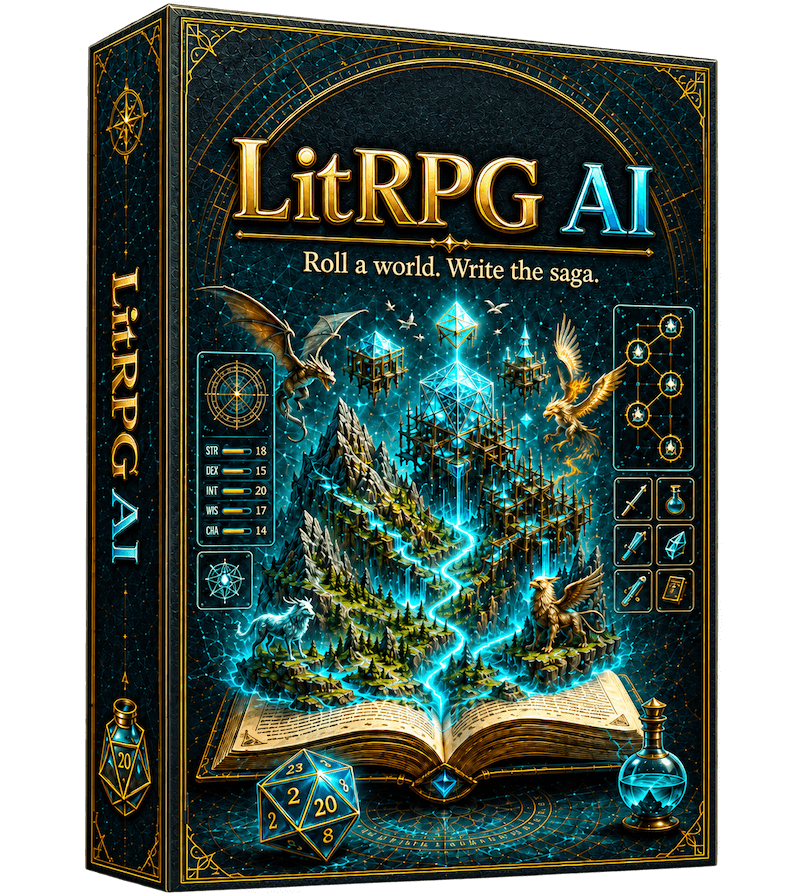
The box image is linked from the product asset URL supplied in your brief. It represents the product branding; it is not proof of actual feature performance.
Image availability depends on the external asset host. For a more reliable Hostinger setup, download approved image assets into your own assets/ directory with the vendor's permission.
Product artwork unavailable from the third-party host.
LitRPG's game mechanics can support many kinds of fiction. The seller describes ten core story directions; these examples show the range without copying its promotional descriptions.
Explore dangerous floors and overcome rising challenges.
Build a livelihood through recipes, tools and skill.
Develop a community and defend what it creates.
Follow an unusual protagonist through new forms.
Train, compete and move through a ranked world.
Let abilities unfold through a growing card collection.
Find satisfying progress in quieter everyday goals.
Make companionship and creature growth the core.
Guide a team and make strategic choices.
Combine traditional plots with transparent progression.
Illustrative category cards; not representations of the actual product UI.
The product material points to an in-house example novel called The Unranked Mage. It reports a 30-chapter manuscript of 82,215 words and a 267-page print layout at 6 × 9 inches.
Those figures indicate the scale of the developer's example, not a promise that every generated book will have equivalent quality or length. A finished novel still requires story editing, line editing, factual checks and publishing decisions.
Figures reported in the supplied promotional material; sample manuscript not independently reviewed.
A novel-sized output is a starting point.
Editorial judgment makes it a book.
In addition to writing and export tools, the seller describes a hosted author page for each of three pen names. The idea is straightforward: people who finish your first book should have a reliable place to discover the rest of your series.
According to the provided specifications, author pages can display books, series, a biography drawn from information you supply, and social profile links. Four visual themes are described.
Most writers can get a chatbot to draft an exciting sword fight. It is much harder to make that fight obey the rules established twenty chapters earlier.
A genre-specific workflow can reduce the mental overhead of tracking stats and series continuity, while leaving the important creative choices with the author.
A consistency tool can flag mistakes. It does not replace an editor, guarantee a compelling novel or ensure that readers will buy the book. The strongest result still comes from careful human review.
Based on supplied launch material; confirm current limits with the seller.
Software is only valuable when it solves a problem you actually have.
Useful if you want guidance through story setup and chapter planning, but are prepared to edit and learn publishing basics.
Potentially helpful if consistent leveling systems, character progression and recurring world details are slowing your process.
Worth examining if your goal is a linked series and you need better continuity from one volume to the next.
Both can assist with writing. The meaningful question is how much supporting work you need to build yourself.
| Writing task | LitRPG AI (advertised) | General-purpose AI chatbot |
|---|---|---|
| LitRPG-specific starting framework | Genre templates and guided choices | Requires custom prompting and setup |
| Long-term character statistics | Running stat records and checks | Usually requires external tracking |
| Chapter planning | Reviewable, editable chapter plans | Possible with manual prompting |
| Series continuity | World map and sequel-oriented tools | Requires careful context management |
| Cover and publishing files | Integrated publishing workflow | May require several separate tools |
| Human editing | Still needed | Still needed |
Vendor-supplied launch information lists three one-time-payment tiers. These are reference prices, not a live checkout quote.
One-time payment • 250 starting credits
One-time payment • 400 starting credits
One-time payment • 600 core + 200 promotional credits (if eligible)
Credit estimates assume a standard book with minimal retries. Revisions and optional publishing steps can consume additional credits. Launch bonuses, plan pricing and availability may change. Confirm all terms at the final vendor checkout.
The supplied product description says the initial plan is purchased once and includes starting AI credits. This does not necessarily mean unlimited future generation. Review the price of additional credits, licensing conditions, checkout order bumps and any optional upgrades before placing an order.
Discount claims: We do not advertise a “90% off” promotion without a verifiable original price and active offer. The amounts above are the launch prices stated in the provided materials.
Extra features deserve the same scrutiny as the base software. The supplied launch sheet distinguishes ongoing plan tools from time-limited additions.
The Legend tier is described as allowing books to be created for clients commercially. Confirm the written licence and its permitted uses before taking client work.
A Chrome-side companion for organizing KDP listing inputs is advertised for Legend. Treat it as preparation assistance, not an automatic publishing guarantee.
The launch promotion describes extra credits if a qualifying book is published within the stated period. Eligibility and verification conditions should be checked.
The supplied text lists 600 core credits plus 200 bonus credits for Legend during the qualifying launch period, giving 800 credits in total.
The supplied schedule advertises a live walkthrough on November 5, 2026, at 8 p.m. ET, with a replay and transcript for eligible purchasers.
The promotional material gives November 1, 2026, at 11:59 p.m. ET as the launch-week end. This is a seller-stated deadline, not a live availability check.
There is a difference between promising features and independently verified results. Here's what looks useful—and what still deserves checking.
We have not received independently verifiable buyer testimonials for this website. Rather than publish invented names, photos, star ratings or quotations, this page focuses on feature analysis and buying criteria. Customer feedback can be added when actual purchasers provide permission and verifiable comments.
Editorial status: This assessment is based on the supplied promotional material; it is not presented as a hands-on software test or a verified customer experience.
The materials provided by the vendor describe a 14-day refund window. They also state that users can keep the Word document of a book they created, while access and remaining credits are removed after a refund.
Before buying, verify the currently published refund conditions directly with the seller or the payment processor, including when the period begins and how requests are submitted.
View Vendor Information ↗This independent website does not process payments or issue refunds.
Practical answers to the questions worth asking before opening your wallet.
The studio is advertised as beginner-friendly, with guided choices and structured setup. New writers should still expect to learn editing, cover evaluation, publishing and marketing fundamentals.
The vendor describes support for longer manuscripts, with standard 30-chapter books and other length options. Final results depend on credit use, editing and the workflow chosen.
The supplied material describes a running character record and checks for numeric or continuity issues. As with any automated checker, authors should validate the final manuscript themselves.
According to the vendor materials, AI use is included in the studio's credit system and does not require a separate ChatGPT subscription or API key.
The provided launch information lists Adventurer at $17, Hero at $27 and Legend at $47, each described as a one-time purchase with different starting credits. Confirm up-to-date prices and extras at checkout.
No. The plans list a fixed starting credit allowance. The vendor says those credits do not expire; confirm top-up pricing and usage policies before purchasing.
The software is marketed with publishing file exports and listing assistance for Amazon KDP. You are responsible for meeting Amazon's latest content, rights and AI-use requirements, and for approving your final book.
The supplied material describes support for multiple series and books, with limits stated as three series and up to five books in each. Actual output depends on available credits and the current plan.
No. Software can support production, but readership, sales and earnings depend on book quality, market demand, pricing, promotion and many other factors.
The supplied vendor copy describes a 14-day refund period. Check the official checkout and current policy for exact requirements.
No. This is an independent affiliate-supported informational website. The product vendor's page is available at litrpgai.com/live.
Offer buttons open our affiliate destination, which may continue to the seller's checkout. We may receive a referral commission if you purchase through the link.